
Babel’s Blessing: When AI Feels Like a Touch of Pentecost
Let’s be honest. For many of us, the Tower of Babel story in Genesis 11 is a straightforward tale of pride and punishment. Humanity overreaches, and God responds by confusing our languages, scattering us across the earth. It’s a narrative that has long been used to explain, and sometimes even justify, the deep divisions we experience.
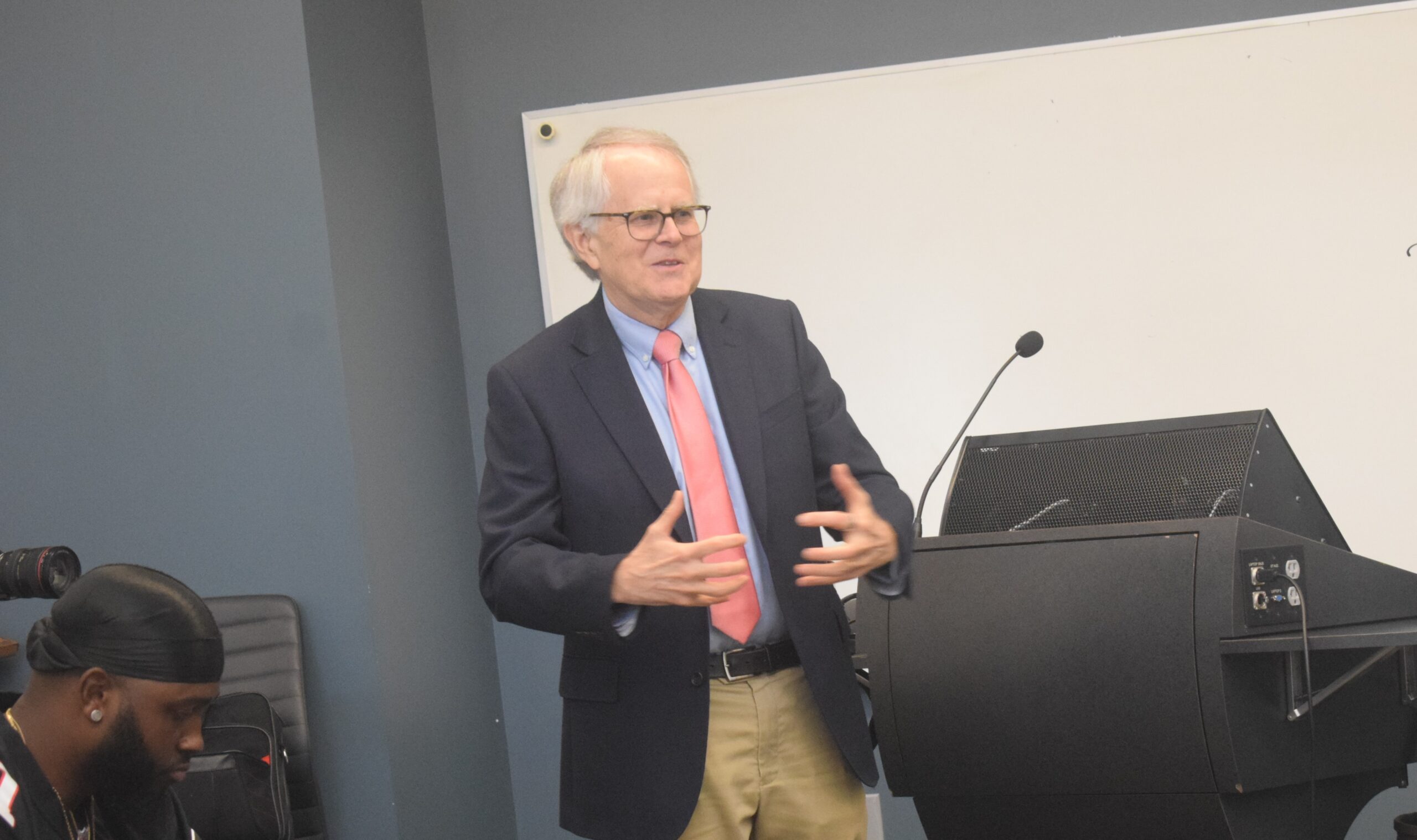
On September 19th, I had the privilege of sitting under the teaching of Dr. William P. Brown, a renowned theologian and biblical theologian, and the William Marcellus McPheeters Professor of Old Testament at Columbia Theological Seminary. He posed a question that has stayed with me: “Was the outcome of Babel a punishment, or was it actually a blessing?”
This question left me with reflections. What if the scattering was not the end of the story, but the beginning of a divine strategy for preserving humanity?
The Real Sin of Babel: The Imperial Impulse
Dr. Brown argued interestingly that the core sin at Babel was not architectural ambition, but the desire for what we might call an imperial impulse*. The people declared, “Come, let us build ourselves a city… lest we be scattered over the face of the whole earth” (Genesis 11:4). Their goal was a forced uniformity, a monolithic culture where one language and one identity would dominate. This was a direct rebellion against God’s creative mandate in Genesis 1:28 to *”fill the earth,”* a command that inherently blesses cultural and geographical diversity.
As Dr. Brown put it, “God’s act of confusing their language was a liberating act. It shattered a dangerous monopoly on power.”** From this perspective, the scattering was not the primary punishment; it was the necessary cure for the disease of homogenization. God, in His wisdom, enforced the beautiful, complex diversity He always intended for creation.
A Rotterdam Moment: An Echo of Pentecost?
This thought took me back to the 88th IFLA World Library and Information Congress, August 2023, Rotterdam, the Netherlands, where I served as a volunteer. The hall was like the entire world coming together, with a vibrant mix of accents, languages, and cultural perspectives. Then, we were asked to log in to a translation mobile app. As the speakers began, we heard them in our desired languages. I heard clear English, while my neighbor listened in Dutch, and another in Arabic and so on. I believe this was not a way of going back to Babel, where everyone was forced into a single language. Instead, it felt like it was one of the practical fulfillments of Pentecost, where each person heard and was understood in their own tongue (Acts 2:6-8). Technology was preserving our distinct cultural voices while building a bridge of shared understanding. I look back on that experience and wonder, “Is this not an indication of the Spirit’s work in our time?”
Miracle and Mechanism
Now, I must pause. I can already feel the thoughtful objections from my Pentecostal and charismatic brothers and sisters, and they are right. The gift of tongues in Scripture, apart from the fact that the disciples heard each other in human languages as in Acts 2:4, also includes a profound mystical dimension. A heavenly language for communicating with God (speaking in tongues), as in 1 Corinthians 14:2. I fully affirm this.
While I have not witnessed someone naturally speak an unlearned human language as the apostles did, what I saw in Rotterdam, I thought, was the functional outcome of that miracle. Seamless understanding across profound divides. If the Spirit’s purpose at Pentecost was to make the gospel comprehensible to all nations, then could we not see this technological development as a manifestation of God’s common grace? Could it be that God, in His wisdom, is granting humanity the knowledge to create tools that participate in healing the fractures of Babel?
Practical Theology in Motion: My Reflections as a New Scholar
This is where my heart as a new scholar of practical theology beats fastest. Theology is not just for the classroom; it must move into the street. I believe Theology is not meant for the seminary library and archives shelves alone; it must step into the streets of our daily lives. The question is no longer whether diversity is a blessing; Babel and Pentecost together show us what it is. The urgent question is how and for what purpose we will use the tools God has allowed us to develop.
- Are we using powerful technology like AI to build new digital towers of control and misinformation?
- Or are we using it to connect as a bridge-building tool, to foster the kind of understanding that reflects the Spirit of Pentecost?
The miracle of Pentecost was that everyone understood. Today, we hold an amazing instrument that can make that understanding a tangible reality. The real test is our willingness to use it for the glory of the God who delights in diversity and desires true unity.
Ayodele John Alonge
Written on Saturday 20th September, 2025, 06:00am (EST)
This reflection was inspired by the profound insights of Dr. William P. Brown during his lecture on The Primeval History (Genesis 1-11) at Columbia Theology Seminar, Decatur, Georgia


Dr Alonge, this is thought provoking. The building of the Tower of Babel had nothing to do with architectural issues but intent of the heart of the builders. This resonates well with me
John
This is profound. Looking at relationship of Babel event and Pentecost experience makes me to think about God’s plan to expand the earth with people of divers languages from different parts of the world still come together to worship God not in the same language but in unity of the spirit. Thank you for this post.